
For months, US President Donald Trump has insisted his administration’s campaign in Venezuela is a counter-narcotics mission. Washington’s talking points lean heavily on the fentanyl crisis, the need for decisive action, the dangers of “transnational criminal networks.” Yet the U.S. State Department’s own 2025 report names Mexico and China as the only significant fentanyl sources affecting the United States. The document is explicit. The drug flows that reach American streets originate almost exclusively from the cartels just across the southern border and China
Venezuela is not mentioned. Not once.
If the intelligence community had uncovered Venezuelan fentanyl pipelines, they would have appeared in the flagship document designed to guide the administration’s national security priorities. They did not. So the White House narrative enters the realm of political theater the moment it is uttered.
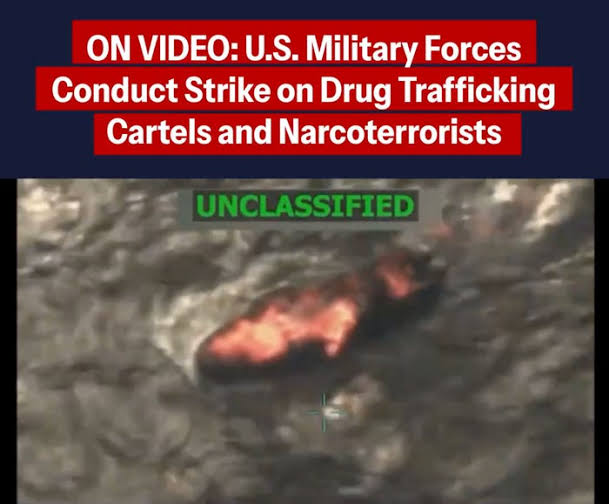
Still the bombs fall. Twenty-one strikes. Eighty-three dead. Zero evidence presented to Congress, the press, or the public. A war fought without the burden of proof.
NBC News reported what U.S. officials privately acknowledge: Caribbean drug vessels move cocaine to Europe. Not to Miami. Not to Houston. Not to Los Angeles. The region is a corridor for products headed across the Atlantic, not a funnel into the United States. The facts collapse the pretext, but the operation continues as if facts are an inconvenience to be managed rather than a constraint to be respected.
The scale of American mobilization tells the real story. Fifteen thousand troops moved into readiness. The USS Gerald R. Ford pulled from the Mediterranean, where it was central to NATO posture. Defense contracts quietly extended to 2028. The logistics resemble a long campaign, not a surgical drug interdiction.
Washington is not preparing for a raid. It is preparing for an era.
The number that illuminates this strategy sits beneath Venezuelan soil: over 300 billion barrels. The largest proven oil reserves on Earth. Seventeen percent of global supply. Tens of trillions in potential value. At a time when global energy markets face both transition and volatility, the incentive to shape the political future of a state sitting on that much petroleum is overpowering.
The New York Times reported that Nicolás Maduro, in an attempt to de-escalate, offered expanded access to U.S. companies. The administration rejected the offer. The message was unmistakable. Concessions were insufficient. Permission was insufficient. Washington was signaling that a partner at the negotiating table is no longer the objective. A reconfigured geopolitical arrangement is.
The fissures inside the U.S. government underscore the stakes. The commander of U.S. Southern Command resigned after his senior legal adviser raised concerns that the operation could violate international law and domestic authorities governing the use of force. The objections were sidelined. The commander walked away. This is not the normal churn of senior leadership. It is a rupture. A warning from inside the national security bureaucracy that the legal foundation for the strikes has been stretched past its breaking point.
The UN High Commissioner for Human Rights stated unequivocally that the operation does not meet international law standards. The Office of Legal Counsel, according to reporting from multiple outlets, drafted an internal opinion saying the administration lacked authority to conduct strikes inside Venezuelan territory. That memo has not been released. It has not been contradicted. It lingers in the background like an unburied truth.
Despite these warnings, Donald Trump announced that land operations are coming “very soon.”
The distance between the stated mission and the mobilized assets exposes the transformation underway. This is not a drug war. It is something older, more structural, and more consequential for the global system. The operation in Venezuela is an experiment in redefining when and how Washington can use military power beyond its borders.
The steps are becoming familiar. Designate a foreign government’s security apparatus as a terrorist organization. Declare an “armed conflict” with those actors. Invoke war powers meant for battlefield engagements. Bypass the diplomatic, legal, and congressional checks that were designed to slow the march to war.
Are you enjoying reading this post? Receive Notifications via email when new articles are published
The Westphalian idea that sovereignty is inherent in statehood once served as the cornerstone of international order. It rested on the principle that borders and governments possess legitimacy because they exist, not because they are granted approval from a more powerful state. That principle is being rewritten in real time. The new doctrine frames sovereignty as a privilege, withheld or revoked when Washington identifies a threat – or an opportunity.
Venezuela is the proof of concept.
This is why the fentanyl narrative matters less than the strategy beneath it. Once a foreign military is reclassified as a terrorist entity, the line between internal criminal pursuit and international armed conflict dissolves. The government of that state becomes something other than a government. It becomes a sanctuary for extremism. When that redefinition takes hold, the threshold for intervention drops to almost nothing.
It is a legal alchemy that transforms political disagreement into battlefield authority.
This is why the military posture is so large. Why the Gerald R. Ford moved oceans. Why contractors are preparing for years, not months. Why a conflict supposedly aimed at drug boats requires American ground forces positioned for rapid deployment.
The real objective lies beneath the surface: repositioning Washington as the decisive power over the world’s most valuable energy reservoir while testing the boundaries of a new legal doctrine that allows intervention without the burden of war declarations. A doctrine that, once solidified, will not remain confined to the Caribbean.
If sovereignty can be suspended in Caracas, it can be suspended anywhere the United States identifies instability, criminality, or governance failures that intersect with strategic interests. Venezuela is not an end. It is a model.
Nations sitting atop rare earth minerals, lithium fields, or large oil and gas deposits will feel the shift first. Nigeria, the Democratic Republic of Congo, Bolivia, parts of Iraq. Countries where the government is contested, where corruption is documented, where human rights concerns already feature in State Department briefings. These states are vulnerable to the same logic that is now being tested on the Venezuelan frontier.
The operation marks a return to a pre-1945 world in one important respect: the strong decide the jurisdiction of the weak. The difference today is that the language of humanitarianism, counterterrorism, and organized crime offers a ready-made vocabulary to justify actions once recognized as violations of the international order.
This is the quiet transformation underway. The political class focuses on fentanyl because fentanyl is familiar. It is frightening. It answers a domestic need. But the officials overseeing U.S. posture in the region understand the wider implications. They understand what it means to shift the legal definition of a foreign military. They understand that redesignating a state actor as a criminal organization opens the door to a new form of intervention that blends police logic with wartime authority.
They understand that what happens in Venezuela does not stay in Venezuela.
This is why lawmakers in Washington have begun sounding alarms. Not because they oppose force on principle, but because they recognize the precedent. When the executive branch acquires the ability to conduct major military operations without congressional authorization by reframing the target, the constitutional architecture tilts toward unchecked power. The costs will not be borne in Caracas alone.
The Venezuelan government is far from innocent. The country’s political institutions have decayed under years of internal authoritarianism and external pressure. The state is deeply entangled with corruption networks. Democratic norms have eroded. None of this explains the scale of the current operation. And none of it resolves the central contradiction: the American public has been asked to support a war without being shown the evidence that supposedly justifies it.
The absence of publicly released intelligence is not an oversight. It is a design choice. Evidence constrains governments. Silence frees them.
As the operation expands, the world is adjusting to the reality that Washington is willing to suspend the sovereignty of a resource-rich nation without compelling justification. Analysts in Europe, Asia, and Latin America are recalibrating their models because the physics of international relations are shifting. Power is being exercised according to a doctrine that was not announced, debated, or voted on. It has instead been unveiled through action.
The significance extends beyond Venezuela’s borders. If the operation succeeds politically – not militarily, but politically – it becomes a template. Future administrations will inherit a tool that allows intervention without the diplomatic process that once defined legitimacy. A tool forged in the Caribbean could be deployed in Africa, the Middle East, or Latin America again. Wherever resources are abundant and governance is fragile.
This is how new eras in foreign policy begin. Not with declarations or treaties. With the normalization of actions that would have once been unthinkable.
Venezuela is where Washington is testing whether the world will accept this normalization. The stakes are larger than the Western Hemisphere. Larger than oil. Larger than the opioid crisis invoked to justify the first strike.
The question at the center of this moment is whether sovereignty is still a right or whether it has quietly become a conditional arrangement managed by global powers. The answer will shape the next decade of international politics.
Venezuela is the first case study in a doctrine that was never named, debated, or ratified.
It is the hinge on which a new order might turn.
And the rest of the world is watching.
Did you enjoy reading this post? Receive Notifications via email when new articles are published
Latest Articles
- Building The United States’ Golden Dome Missile Defense System And How To Start A Space WarIn May 2025, the world got a first-hand look at what a modern missile defense system looks like during a major international conflict, when Israel attacked Iran and triggered a rapid retaliation. What most people saw was a piece of Israeli Missile Defense system referred to as the Iron Dome. But that name hides a more complicated reality. The Iron Dome is only the lowest …
- IshowSpeed coming to ZimbabweMarondera – Darren Jason Watkins Jr., the American internet personality better known as IShowSpeed, is expected to visit Zimbabwe as part of an ambitious tour spanning 20 African countries, a move that signals a growing shift in how global digital culture engages with the continent. Watkins, just 20 years old, has become one of the most influential livestreamers of his generation, commanding tens of millions …
- Us vs ThemThere’s no “us.” There’s no “them.” There’s only the comfort of pretending there is. People need enemies the way lungs need air. Conflict gives meaning to the meaningless.Without opposition, identity collapses. So we build one. We draw lines on maps, then forget who drew them. Every tribe begins as fear, then calls itself culture.We love belonging because it saves us from thinking.It’s easier to chant …
- We Turned Horniness Into An IndustryLet me explain this slowly, because if you blinked for five minutes in June, you might’ve missed the moment humanity officially gave up pretending it had standards. An actress, Sydney Sweeney, famous, attractive, very online-adjacent, partnered with a men’s grooming company called Dr Squatch to release a limited-edition bar of soap. Five thousand bars. Eight dollars each. And the marketing hook, the thing that made …
- Smoke ScreensThe Epstein Files were supposed to be a revelation.A ledger of the powerful written in ink, not whispers.Promises were made. Promises were repeated.They claimed the truth would come out.The fog would lift.Transparency was the campaign slogan. Then the files arrived.And almost everything was blank.Pages upon pages covered in black boxes.Names, conversations, details, gone.Block after block of censorship.Critics call it about 90 percent redacted. That is …
- The Redacted States Of AmericaThey finally released the Epstein files. And by “released,” I mean they handed the public a stack of black rectangles wrapped in patriotic bullshit and said, ‘here you go, transparency.’ Not truth, mind you. Not accountability either. Transparency cosplay. The kind where the light technically passes through, but you still can’t see a fucking thing. Page after page after page looks like it lost a …
- We Cant Have Shit AnymoreSomewhere out there, a very tired underpaid FBI agent had to write a sentence that would’ve sounded insane just ten years ago. “Criminals may use AI-generated images to fake kidnappings and demand ransom.” That sentence alone should qualify us for a species-wide timeout. And of course the internet did what the internet does and immediately joked about how this will disrupt the real kidnapping industry. …
- Africa is The New Cold War FrontYou ever feel like the whole damn planet suddenly remembered Africa exists. Not because they actually give a shit about Africans, but because the minerals are running low everywhere else and China has been scooping up the continent like it’s a Black Friday sale? Because that’s exactly what’s happening. And now, out of nowhere, every global superpower is acting like they’ve always loved us, like …
- My Unorthodox Thoughts On The US-Zimbabwe Partnership ResetOh look! America and Zimbabwe are “starting fresh.” Again. For the 900th time. The U.S. has now discovered that Zimbabwe could be “a great partner.” No shit, Sherlock. Anyone can be a great partner as long as they have lithium, gold, and a government desperate enough to smile at whoever shows up with a business card. And the Herald is acting like this is the …
- The World Didn’t Sign Up To Be America’s Captive Audience (But Here We Are)Sometimes I look at my social media feed and wonder when exactly I became an unpaid U.S. political analyst, commentator or whatever. I live thousands of kilometers away, my taxes don’t go there, I don’t vote there, and yet every day I’m force-fed a steady diet of American political drama like it’s my emotional multivitamin. I open TikTok: screaming match between a congressman and a …
- America’s Love Affair With “The End Of The World”Some days I think the United States doesn’t actually want to fix anything. I think the country is addicted to decline the same way some people are addicted to astrology. I think that’s bcause it’s easier to believe Mercury is in retrograde than to admit you forgot to pay your bills. Everyone is screaming about apocalypse like it’s a sport. Right-wing apocalypse, left-wing apocalypse, climate …

 Zealous Thierry
While international and more-local merchants of the drug-abuse/addiction scourge must be targeted for long-overdue political action and criminal justice, Western pharmaceutical corporations have intentionally pushed their own very addictive and profitable opiate resulting in direct and indirect immense suffering and overdose death numbers for many years later and likely many more yet to come.
It indeed was a real ethical and moral crime, yet, likely due to their potent lobbyist influence on heavily-capitalistic Western governance, they got off relatively lightly and only through civil litigation. … Instead, drug addiction and addicts are misperceived by supposedly sober folk as being weak-willed and/or having committed the moral crime.
People who self-medicate should not feel embarrassed or ashamed about their addiction(s). The greater the induced euphoria or escape one attains from it, the more one wants to repeat the experience; and the more intolerable one finds their non-self-medicating reality, the more pleasurable that escape will likely be perceived. In other words: the greater one’s mental pain or trauma while not self-medicating, the greater the need for escape from one’s reality — all the more addictive the euphoric escape-form will likely be.
LikeLiked by 1 person
it’s tru that the opioid crisis in the US didn’t begin in clandestine labs but in corporate boardrooms with painkillers marketed as non-adictive. And I thinkthat history is precisely why Washington’s fixation on Venezuela rings hollow. A Gvt that never truly confronted the domestic, corporate-driven origins of the epidemic is now invoking fentanyl abroad as a justification for a completely different geopolitical project.
LikeLike
There must be a point at which corporate greed thus practice will end up hurting big business’s own monetary interests. Or is the unlimited-profit objective/nature somehow irresistible? It brings to mind the allegorical fox stung by the instinct-abiding scorpion while ferrying it across the river, leaving both to drown.
Could it be that a bunch of morbidly and self-mortally greedy corporate officers may know their big businesses will inevitably, if not imminently, collapse due to a great lack of consumers who can afford those big businesses’ products — perhaps including some would-be consumers who’d lost their jobs to employer-profit-maximizing AI or other forms of automation); yet, the corporate officers will nonetheless continue ardently politically supporting (via covert lobbying of governments, of course) the very economic system, especially its below-poverty-line minimum wage, that’s basically going to ruin their big businesses?
As strange as it likely sounds, perhaps those corporate officers cannot help themselves, and they realize an intervention by a truly-independent body/entity may be needed, one completely untouchable by the morally- and/or ethically-corrupt corporate lobbyists. ‘We scorpions simply cannot help ourselves. We need externally independent intervention, but we will still resist it. It’s in our nature.’
Regardless, corporate officers will continue shrugging their shoulders and defensively saying their job is to protect shareholders’ bottom-line interests. And the shareholders also will go on shrugging their shoulders while stating they just collect the dividends and that the big bosses are the ones who make the decisions involving ethics or lack thereof.
But can such insatiable-human/corporate-greed nature really be that morally hopeless, indeed pathetic?!
LikeLiked by 1 person
Looks like Trump is going ahead despite all the dangers it poses to the International Order. Very well written. Thank you for sharing.
LikeLiked by 1 person
Thanks for reading. The operation may look like a regional issue, but it touches the foundations of the post-1945 order. If this becomes normalized, it will reshape how powerful states deal with resource-rich but politically fragile countries across the world.
LikeLike