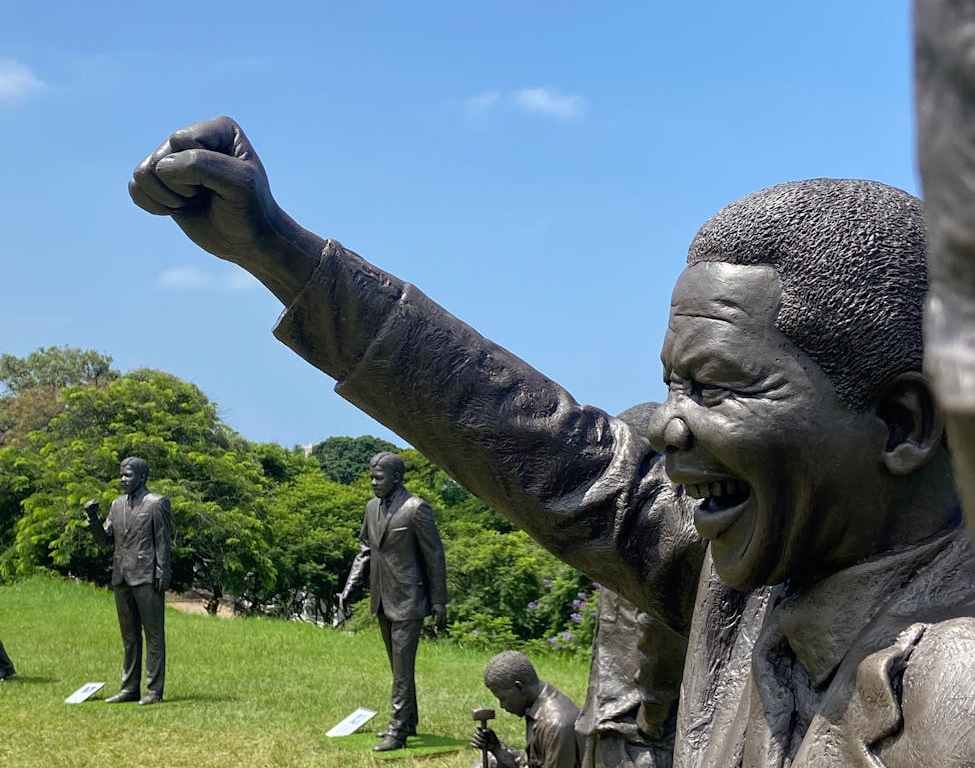
What public figure do you disagree with the most?
There are few figures in modern history as globally revered as Nelson Mandela. His story has become mythic. 27 years in prison followed by a peaceful transition to democracy, crowned by his magnanimous embrace of those who once dehumanized him. Statues, street names, and documentary reels ensure that his image radiates eternal light. And yet, as a child of a continent still reckoning with the wounds of colonialism and the choreography of postcolonial betrayal, I find myself in ideological disagreement with Mandela. Not because I dismiss his courage. Not because I ignore his sacrifice. But because I do not believe that peace, at any cost, should be mistaken for justice.
This is not an easy confession to make. Not in an era where Mandela’s legacy is used as a moral compass, often selectively and superficially. To disagree with him feels like heresy in polite political company. But I am less interested in politeness than I am in truth. And the truth is this: Mandela’s philosophy of national unity, though noble in intent, has been weaponized across Africa to silence pain, pardon power, and manufacture a peace that is only skin deep.
To be clear, I do not reject reconciliation as a principle. I reject the idea that reconciliation should precede, or worse, replace, accountability. I reject the political theatre where victims are asked to smile at their perpetrators in the name of national healing. I reject the myth of the “rainbow nation,” because I know that rainbows do not last; they fade. And what remains after their disappearance is often the unfinished work of justice that was skipped for the sake of applause.
Growing up in Zimbabwe, I watched our leaders cite Mandela’s example not to emulate his humility, but to mimic his politics of managed forgetting. They told us that to demand justice for Gukurahundi was to “reopen old wounds.” They warned that to interrogate the looting of liberation war heroes was to “undermine national unity.” I have seen how the language of unity, once liberatory, has become a muzzle. I have heard leaders invoke Mandela to silence the truth. That is my quarrel, not with the man himself, but with the myth he has become.
There’s a certain comfort in believing that entire nations can heal through symbolic gestures, a stadium handshake, a televised apology, a Truth and Reconciliation Commission with no teeth. But trauma is not symbolic. It lives in the bones, in the soil, in the silences passed down like heirlooms. The victims of apartheid were not healed by public forgiveness. The wealth stolen by apartheid architects was not redistributed. The systems of economic and racial inequality did not evaporate. They adapted. They changed clothes. And in the afterglow of Mandela’s presidency, South Africa became the most unequal society in the world.
Still, the world applauded.
What does that tell us?
It tells us that the world is far more comfortable with stories of forgiveness than with stories of resistance. It tells us that the global imagination prefers the reconciled African to the defiant one. The African who embraces the oppressor is a global icon. The African who demands justice is a threat to stability. In this way, Mandela was elevated not only for what he did, but for what he symbolized: the possibility that Black rage could be tamed, that the colonized could become co-managers of the status quo.
This is not Mandela’s fault alone, but it is the cost of iconography. Once a man becomes a saint, the complexity of his politics is flattened. Nuance is erased. Criticism becomes taboo. But we do not honor legacies by shielding them from scrutiny. We honor them by engaging them honestly, even when it is uncomfortable.
It is uncomfortable to say that South Africa’s transition to democracy left many wounds untouched. It is uncomfortable to say that the mining companies that financed apartheid continued to thrive under ANC rule. It is uncomfortable to say that forgiveness was not a collective choice, but a political strategy. And it is deeply uncomfortable to say that perhaps the model of peaceful transition so admired by the West was, in some ways, a quiet burial of justice.
Mandela’s greatness is not diminished by these questions. But neither should these questions be buried beneath greatness.
In Zimbabwe, we were told to “move forward” after every betrayal. After every election marred by violence, we were told that unity mattered more than accountability. After every massacre, every land grab, every wave of political repression, the mantra of peace was sung like a national hymn. I began to understand that in the mouth of the powerful, “unity” often means silence, and “peace” often means obedience.
What Mandela’s philosophy failed to interrogate: what many postcolonial governments still refuse to interrogate, is who gets to define unity, and who pays for it. Because unity without justice is not neutral ground. It is a negotiated silence, often demanded from the already wounded, never from the powerful.
It is the mother in Matabeleland who is asked to shake the hand of the man who ordered the death of her sons. It is the farmworker who is told to accept reconciliation while the land he tills still belongs to his ancestor’s dispossessors. It is the activist who is asked to moderate their tone in the interest of national harmony. All the while, the architects of injustice are left intact—wealthy, protected, and unaccountable.
Is that peace? Or is that performance?
Mandela chose peace over war, and that choice saved lives. That much is undeniable. But we must also ask what was lost in that decision. Not to condemn him—but to ensure that the generations who come after us are not shackled by the same euphemisms.
I do not dream of a continent that is merely stable. I dream of a continent that is honest. Where truth is not sacrificed on the altar of nation-building. Where healing is not forced. Where justice is not deferred. And where the past is not brushed aside to make room for a sanitized future.
I dream of a different kind of unity—the kind built on truth-telling, not truth-burying. The kind that can survive discomfort. The kind that does not ask the oppressed to smile for the camera while the wounds of history remain untreated.
So yes, I disagree with Nelson Mandela. Not out of ingratitude, not out of cynicism, but out of love for the people whose suffering was too often glossed over in the name of “greater good.” I disagree with the idea that we must trade justice for calm. I believe we deserve both.
And I believe that the next generation of African leaders must learn from Mandela, not worship him. They must build on his legacy—not replicate it blindly. They must have the courage to say: peace is not enough, if it leaves the wounds open. Unity is not enough, if it is enforced. And reconciliation is not enough, if it forgets.
The world may continue to celebrate Mandela’s legacy as the gold standard of statesmanship. That is its right. But my allegiance is not to the myth. It is to the truth. And the truth, as I have seen it, is this: unity without justice is not unity at all. It is just silence, dressed in the robes of peace.

 Zealous Thierry
Deep thoughts and v.well written
LikeLiked by 1 person
Well, thank you Craig. It means a lot
LikeLike
Thank you so much for this. It means a lot that the piece resonated beyond our borders, because truly, the aftershocks of colonialism, betrayal, and the politics of ‘forgiveness over justice’ echo throughout the diaspora. Our pain may differ, but the patterns are hauntingly familiar. I appreciate you reading with an open heart.
LikeLiked by 1 person
Excellently written: I never thought of it like that. It’s a reality of the black experience in the Americas as well. Thanks for the article
LikeLiked by 1 person