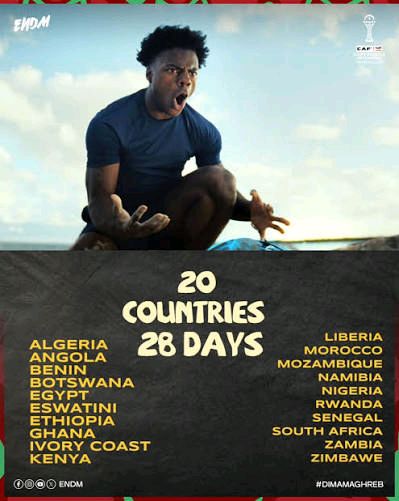

Marondera – Darren Jason Watkins Jr., the American internet personality better known as IShowSpeed, is expected to visit Zimbabwe as part of an ambitious tour spanning 20 African countries, a move that signals a growing shift in how global digital culture engages with the continent.
Watkins, just 20 years old, has become one of the most influential livestreamers of his generation, commanding tens of millions of followers across YouTube, TikTok, Instagram, and X. His content, often chaotic, spontaneous, and unfiltered, has helped redefine livestreaming as a form of real-time global entertainment rather than a niche internet subculture.
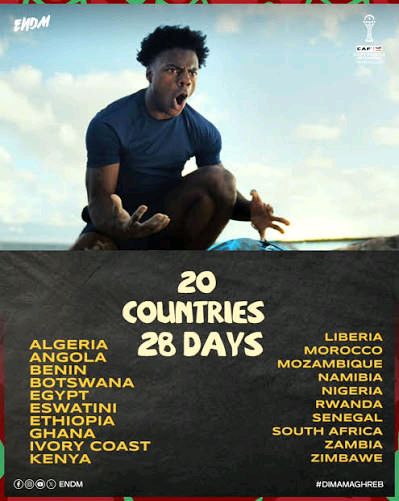
Zimbabwe is among the countries listed on the tour itinerary, alongside South Africa, Nigeria, Ghana, Egypt, Kenya, Morocco, Senegal, Zambia, and others. While official dates and locations have not yet been released, the announcement alone has sparked intense discussion across African social media spaces, particularly among young audiences and local content creators.
This African tour follows Watkins’ high-profile visit to China earlier this year, where he spent several weeks livestreaming daily experiences across major cities including Beijing, Shanghai, and Shenzhen. That trip, which took place around March and April 2024, drew millions of live viewers and generated widespread debate online. Clips of Watkins navigating public transport, interacting with locals, reacting to Chinese food, and exploring city life went viral almost instantly.
More importantly, the China streams demonstrated the power of livestreaming as an alternative lens to traditional media portrayals. For many of his predominantly Western audience, it was their first exposure to everyday Chinese urban life outside the context of geopolitics or state narratives. The success of that visit appears to have influenced the scale and ambition of his African tour.

For Zimbabwe, Watkins’ planned visit carries significance beyond entertainment. Unlike conventional celebrity visits or state-led tourism campaigns, IShowSpeed’s presence represents organic, youth-driven exposure. His livestreams are raw, unscripted, and immediate, showing cities and people as they are encountered, not as curated brochures.
Local digital creators see this as an opportunity to collaborate, gain visibility, and connect with global audiences without relying on traditional media gatekeepers. For Zimbabwean youth, many of whom already consume and participate in global internet culture, the visit is symbolically affirming: proof that the country is not invisible in the digital age.
There is also a soft-power dimension. In an era where perception travels faster than policy, livestreams reaching millions can quietly reshape how countries are viewed, especially among younger audiences who are increasingly skeptical of legacy media narratives.
Nonetheless, Watkins’ African tour reflects a broader trend. Global influencers are increasingly turning to Africa not as a backdrop, but as a central stage. With one of the world’s youngest populations and rapidly expanding internet access, the continent represents both cultural energy and future audience growth.
At the same time, African cities offer what livestreamers value most: unpredictability, human interaction, and authentic moments. These are qualities that algorithm-driven platforms reward, and that audiences respond to.
Although no formal program has been announced for Zimbabwe yet, online speculation is already underway. Fans are debating which cities he might visit, which local creators he could collaborate with, and how Zimbabwean culture might appear through his famously chaotic lens.
Whether one views IShowSpeed as a cultural icon or a digital provocateur, his influence is undeniable. His African tour, and Zimbabwe’s place within it, underscores a shifting reality: global attention is no longer dictated solely by institutions, governments, or traditional celebrities, but increasingly by individuals armed with a camera, a livestream button, and a massive online following.
As Africa continues to assert itself within the global digital conversation, visits like this are less about spectacle and more about visibility, who gets seen, how they are seen, and who controls the narrative.
Did you enjoy reading this post? Receive Notifications via email when new articles are published
Latest Articles
- The Rising Ledger Volume III: At The Brink of World War 3 Issues #51 to #65Issue #51: The Strait Is The Global Food Chain One-fifth of globally traded oil moved1 through the Strait of Hormuz every day. Twenty-two percent of global LNG. Qatar’s Ras Laffan facility which is the source of roughly 20 percent of global LNG exports was struck by Iranian drones and shut down production at the start of the 2026 Iran War. Marine insurance premiums are still …
- The Nuclear Surveillance Architecture is GoneArms control doesn’t just mean treaties. It means inspections. Verification. Satellites watching missile silos. Inspectors counting warheads. Communication channels between adversaries so that a radar malfunction doesn’t get interpreted as an incoming strike. The 1983 Soviet satellite false alarm nearly ended the world. A Soviet officer named Stanislav Petrov chose not to report what his instruments showed as an incoming American first strike, and he …
- India and Pakistan fired Missiles at each otherIn May 2025 — approx ten months ago — India and Pakistan, both nuclear-armed states, engaged in four days of open conflict involving cross-border drone and missile attacks. The Bulletin of the Atomic Scientists described it as “nuclear brinkmanship.” Two countries with a combined nuclear arsenal of roughly 300 warheads exchanged live fire for four days and the world did not end. The crisis de-escalated. …
- NATO Has Less Than Five Percent Of Air Defense Capabilities NeededNATO states have less than 5 percent of the air defence capabilities necessary to protect central and eastern Europe from large-scale attack. That figure comes from the Financial Times, sourced from European officials. Less than 5 percent. The alliance exists and their flags fly. The summits happen. The communiqués are issued. The spending pledges are made. And yet the actual physical infrastructure required to defend …
- The Flying ChernobylRussia tested the Burevestnik nuclear-powered cruise missile in October 2025. The missile is nicknamed “Flying Chernobyl” because it emits radioactive exhaust from its unshielded reactor. It can fly for 15 hours non-stop and cover 14,000 kilometres. Putin says its true range could be unlimited. A nuclear-powered missile with potentially unlimited range that leaves a trail of radioactive contamination wherever it flies. This is a real …
- France Expanded It’s Nuclear ArsenalFrance’s President Macron announced France’s first warhead stockpile increase in over three decades. He also announced a new doctrine allowing French nuclear aircraft to deploy to eight European partner nations. This happened in direct response to what Macron described as US unreliability. Let that sequence sit: the US became unreliable enough as an ally that France, a country that hasn’t added nuclear warheads in thirty …
- Germany Can Only Field Five BattalionsGermany has, on paper, an army of three divisions. In practice, according to a research fellow at the Council on Geostrategy, even with three months’ warning Germany would struggle to field beyond five battalions outside its own borders. Five battalions. Against an adversary that has been on a war footing for four years, that deploys 8,000 kamikaze drones per day in Ukraine, and that has …
- Only 16% of European Citizens Still Consider the United States An AllyIn November 2025, the European Council on Foreign Relations surveyed Europeans about their view of the United States. Only 16 percent still considered the United States an ally. That’s down from 22 percent eight months earlier. Twenty percent now consider the United States a rival or adversary. In Germany, France, and Spain, that number approaches 30 percent. NATO was built on the premise that Europe …
- Nuclear Bomb DominoIran’s nuclear facilities were bombed. The IAEA says the sites weren’t destroyed. Iran still holds 440 kilograms of highly enriched uranium. The Cambridge Centre for the Study of Existential Risk says Iran’s capacity was “marginally degraded” but the incentives to go nuclear have “gone through the roof.” Iran goes nuclear. Saudi Arabia, which signed a mutual defence agreement with nuclear-armed Pakistan in September 2025 and …
- The Nuclear Treaty Expired QuietlyNew START was the last nuclear arms control treaty between the United States and Russia. It limited both countries to 1,550 deployed nuclear warheads each. It required inspections. It required verification. Basically, it was the single remaining guardrail on a combined arsenal capable of ending human civilization several times over. It expired on February 4, 2026. There was no replacement or any negotiations. There was …
- 85 SecondsThe Doomsday Clock started in 1947. It was created by the scientists who built the atomic bomb. These are people who understood exactly what they had made and were terrified of it. For seventy-nine years they have moved that clock forward and backward based on how close the world is to ending itself. In 1991, when the Cold War ended, they moved it back to …

 Zealous Thierry