Unapologetically authentic space for unapologetic reflections on Zimbabwean and Global politics, social justice, and the human condition: blending sharp critique with creative thought to challenge power and inspire change.
Elites, Outsiders and the Illusion of A Bigger Table
21,768 People Read This Article
By
Kumbirai Thierry Nhamo
Time To Read || 6 minutes
Those with the ideas have no power
Unknown
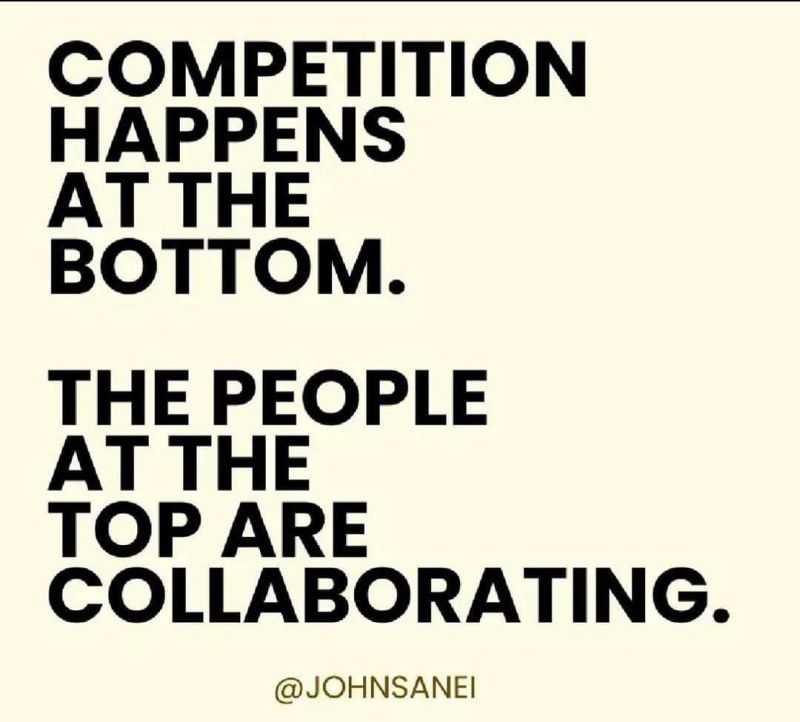
There’s a certain kind of pseudo-wisdom that flourishes in the mouths of motivational speakers. The kind of statement that sounds profound until you think about it for more than five seconds. Among their most cherished mantras is this idea that competition happens at the bottom whilst those at the top of the food chain collaborate. It’s repeated with all the gravity of a universal truth, as though it were passed down from some ancient oracle rather than cobbled together by a motivational speaker on Ms word. In reality, it’s a hollow cliché peddled by people who don’t understand power, have never wielded it, and are deeply invested in ensuring you never question it—because they eke out a living by selling you ideals.
“Competition happens at the bottom. The people at the top are collaborating.”
This is not insight at all. Rather, it is a sales pitch. And like most things sold under the banner of “personal growth,” it flatters the listener at the expense of the truth. The idea that the powerful are up there collaborating while the poor scrap and claw at each other below is a fantasy for people who want to believe that the world is fair, and that the only thing standing between them and greatness is a shift in mindset. It’s motivational speaker pablum: simplistic, comforting, and utterly divorced from how power actually works.
Let’s dispense with the delusion. Those at the top are not floating serenely in a cloud of collaboration, free from the ugly grind of competition. They are not selfless visionaries, joining forces for the greater good. They are not a council of enlightened beings who have transcended the “me” mentality in favor of a noble “we.” Power doesn’t change human nature—it simply gives self-interest more tools and fewer consequences. At the top, it’s still about “me”—always has been, always will be. The only difference is the scale and subtlety of the game.
The collaboration you see among the powerful is not unity. If I were to put a name to it I would say it’s cartel logic. It is backroom deals, whispered threats, strategic handshakes, and non-disclosure agreements. It’s the performance of solidarity to conceal a relentless pursuit of personal advantage. If it looks like collaboration, that’s because it is—but it’s collaboration in the way wolves collaborate to take down prey. Temporary. Tactical. Self-serving. Nothing more.
Someone once quipped—perhaps it was Will Rogers, or Ambrose Bierce; it doesn’t matter—that “Diplomacy is the art of saying ‘nice doggy’ while you look for a bigger rock.” That’s how the powerful collaborate. Smiles for the cameras, knives behind the back. Joint ventures that end in hostile takeovers. Political coalitions that collapse into coups. Industry alliances that exist solely to strangle smaller competitors. This is not “we” thinking. This is “me, but with plausible deniability.”
Yet the motivational speaker doesn’t see this, or refuses to. Their job is to take this cutthroat reality and repackage it as enlightenment. They pitch power as a kind of moral evolution, where the successful rise above competition through the purity of collaboration. What they’re really selling is obedience—an invitation to stop questioning, stop resisting, and start emulating your betters. Stop fighting at the bottom, they say, and maybe one day you’ll be allowed into the warm glow of elite cooperation. This is not empowerment. It’s pacification.
It also happens to be a lie.
Competition doesn’t just “thrive at the bottom.” It exists everywhere. The poor compete, yes—because they’re forced to. For jobs, for housing, for survival. But let’s not pretend the rich don’t compete. The difference is that the rich have already bent the rules in their favor. When billionaires fight over market dominance, when politicians vie for influence, when nations jockey for resources, these are not expressions of elevated collaboration. They’re just higher-stakes versions of the same self-interest the motivational industry likes to scorn in the poor.
This is what makes the myth so grotesque. It implies that people at the bottom are trapped by their own pettiness, too stupid or stubborn to “work together” and lift themselves up. Meanwhile, the rich are paragons of unity, having transcended the dog-eat-dog world below. It’s a sanitized, moralized view of inequality—one that paints the powerful as virtuous and the powerless as defective. According to this logic, poverty isn’t systemic—it’s a mindset problem. You’re not broke because the economy is rigged; you’re broke because you just don’t collaborate enough.
It’s insulting. And it’s wrong.
If anything, history tells the opposite story. The poor have always known how to collaborate—because they’ve had to. Mutual aid, unions, co-ops, protest movements—these are all born from necessity and solidarity. And every time the bottom tries to organize, the top responds the same way: repression. Because the one kind of collaboration the powerful do fear is the kind that threatens their position. They don’t fear your competition. They cultivate it. They fear your unity. That’s when things get dangerous.
So when the elite collaborate, what they’re really doing is consolidating. They form alliances to protect their interests, to exclude outsiders, to maintain control. It’s more self-preservation than generosity (emphasis on the ‘self’) . They don’t “transcend” competition. They suppress it—through monopolies, through gatekeeping, through political capture. And they use the language of collaboration to make it all seem benign.
The motivational speaker, blissfully ignorant or willfully blind, sees this and thinks it’s proof of moral superiority. In truth, it’s just power doing what power does: protect itself. The top is not less competitive; it’s just better at hiding the bodies.
And let’s not forget: collaboration is also selective. At the top, it’s “we”—but only our “we.” It’s insiders, shareholders, donors, old boys’ networks. You’re not invited. Not unless you’re useful. And even then, only until you’re not. That’s the other side of collaboration at the top: you’re in until you’re out. Today’s ally is tomorrow’s threat. Ask any fallen CEO, any exiled politician, any former darling of the elite. Power’s memory is short, and its loyalty shorter.
All of this is lost on the motivational speaker, who continues to preach the gospel of mindset as if thinking happy thoughts and networking hard enough can get you a seat at the table. They confuse access with power, etiquette with strategy. They think success is the reward for being agreeable. In truth, power doesn’t care if you play nice. It cares if you’re useful—and it has no problem discarding you when you’re not.
Here’s the truth: it’s still “me” at the top. It’s always “me.” The collaboration you see is just “me” scaled up, “me” weaponized, “me” with resources. Believing otherwise is not just naïve but dangerous as well. It disarms people, lulls them into believing power is benevolent, fair, and attainable for anyone who tries hard enough. That’s the myth motivational speakers sell. Propaganda on steroids.
So the next time someone tells you that competition is for the poor and collaboration for the rich, don’t be impressed. Be skeptical. Ask who benefits from that belief. Because it isn’t you. And it sure as hell isn’t the poor. It’s the same people who’ve always benefited: the ones holding the bigger rock.
P. S Forgive me if I’m starting to sound like one of ’em motivational speakers lol


 Zealous Thierry