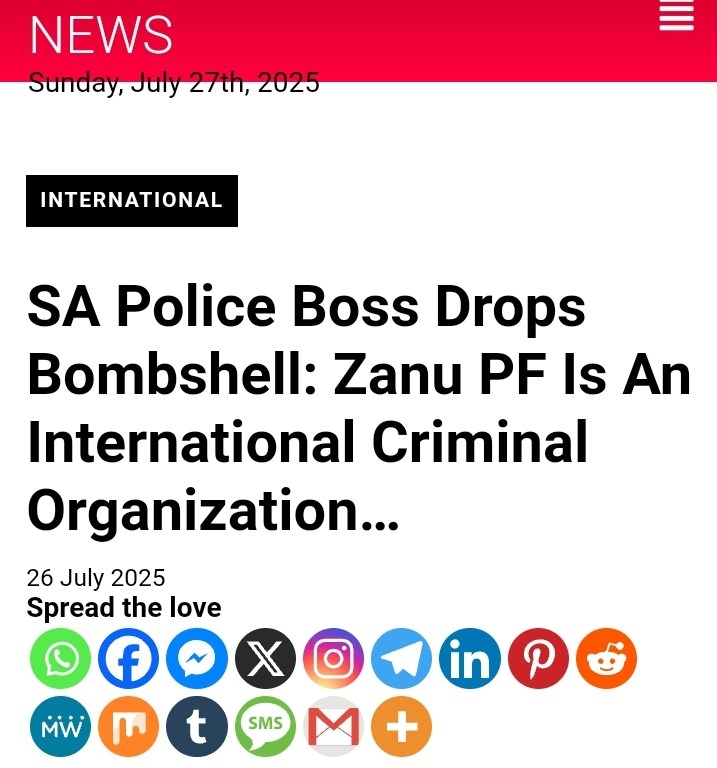

Claim:
An article published by ZimEye on July 26, 2025, alleges that General Nhlanhla Mkhwanazi, Provincial Police Commissioner for KwaZulu-Natal, accused Zimbabwe’s ruling party, ZANU PF, of being an “international criminal organization” in an official report submitted to South Africa’s President.
Assessment:
There is no verifiable evidence that General Mkhwanazi made such a statement or submitted a report making these claims. No other credible news outlet has reported on this alleged bombshell, and there is no official statement from South African police, the presidency, or General Mkhwanazi himself to confirm the accusations detailed by ZimEye.
Context and Verification Process:
1. Absence of Official Confirmation
A thorough review of official police communication channels in South Africa, including the South African Police Service (SAPS) website and verified social media pages, shows no press release, public statement, or report matching the content described in the ZimEye article.
Furthermore, a search across reputable South African media outlets (e.g., News24, Daily Maverick, Eyewitness News) reveals no coverage of this alleged report or its claims.
2. Past Misreporting by the Source
ZimEye has a documented history of publishing unverifiable or misleading articles, including:
A fabricated article alleging that ZEC Chairperson Priscilla Chigumba admitted to rigging elections—a claim later quietly edited out of the original article with no retraction or clarification.
A number of defamatory pieces against journalist Hopewell Chin’ono, which included fabricated evidence and unsubstantiated criminal allegations. Chin’ono publicly refuted the claims, and parts of the articles were later removed.
This pattern of behavior raises significant concerns about ZimEye’s editorial standards, verification practices, and accountability.
3. Lack of Supporting Evidence
The ZimEye article fails to provide direct evidence of the supposed “official report,” such as:
A leaked copy,
A photograph or transcript,
Or a statement from the Presidency acknowledging its receipt.
Instead, the article relies solely on anonymous attribution (“by a correspondent”), with no citations or links to verifiable documentation.
4. Questionable Claims and High-Level Allegations
The claim that ZANU PF is “deploying military-trained gunmen” into South Africa to influence ANC factional battles is extremely serious and, if true, would be a diplomatic scandal of regional significance.
It is implausible that such a major revelation would be reported exclusively by one outlet without any follow-up by major South African or international media.
Conclusion:
The claim that South Africa’s police commissioner labeled ZANU PF a criminal organization cannot be verified through any independent or official sources. Based on the source’s poor credibility record, the absence of corroborating evidence, and the highly inflammatory nature of the allegations, this story fails basic journalistic verification standards.
Until credible evidence emerges, the article should be treated as unsubstantiated and potentially misleading.
Why This Matters:
Fact-checking is not about protecting or attacking any political party—it is about ensuring truth and public accountability, especially in a region where media disinformation is often weaponized. While ZANU PF, like many political entities, faces criticism and allegations, these must be documented with evidence—not fabricated or exaggerated for clicks or political agendas.
Recommendations for Readers:
Verify major claims via multiple reputable sources.
Treat anonymous reports with caution.
Challenge media outlets to maintain editorial integrity, especially when past conduct suggests a pattern of sensationalism or misinformation.

 Zealous Thierry